

Have you ever considered how intrusive sunlight can be inside a building, and how much it can increase energy use? In cities like Yazd, with hot and arid climates, intense solar radiation during the day significantly raises indoor temperatures. In contrast, in northern Iranian cities with temperate and humid climates, the sun’s angle differs, causing glare in the mornings and afternoons and increasing the need for artificial lighting. This makes controlling light and heat entering the building essential.
In passive building design, shading devices are recognized as crucial tools for controlling solar radiation and optimizing energy efficiency. When used effectively, these elements enhance thermal comfort, reduce electricity consumption for heating and cooling systems, and create a more pleasant environment for living and working.

Shading devices, also called solar control systems, are architectural elements designed to manage the amount of light and heat entering a building. They limit direct sunlight, guide natural light, and reduce reliance on mechanical systems, thereby lowering energy consumption.
Passive design aims to reduce energy use and improve thermal comfort without heavily relying on complex mechanical systems. Shading devices help achieve this by blocking direct sunlight in summer and guiding it in winter, maintaining a balanced indoor temperature. Beyond reducing heating and cooling loads, they preserve daylight quality and outdoor views, enhancing the overall user experience.
Shading devices do more than block sunlight; they are a key component of passive design, stabilizing the thermal behavior of indoor spaces. By controlling solar intensity, heat enters the building more uniformly, reducing temperature fluctuations.
This reduces the need for mechanical systems to operate intensively throughout the day. Selecting the proper angle and depth of a shading device based on the sun’s path ensures optimal performance in both hot and cold seasons. As Olgyay notes in “Design with Climate”, analyzing solar paths is fundamental for determining the shape and type of shading device in hot and arid climates.
Controlling the amount of heat entering a space allows HVAC systems to operate more efficiently, avoiding frequent and high-demand cycles. Lower initial loads also allow mechanical systems to work more steadily, consuming less energy. According to the ASHRAE Handbook (2021), external shading devices; especially adjustable types, can reduce a building’s cooling load by 20–30%. This not only lowers energy consumption but also reduces equipment wear and operational costs.
Shading devices are classified as internal or external, each playing a vital role in energy optimization and thermal comfort. Common examples include curtains, blinds, louvers, and fixed or movable shades.
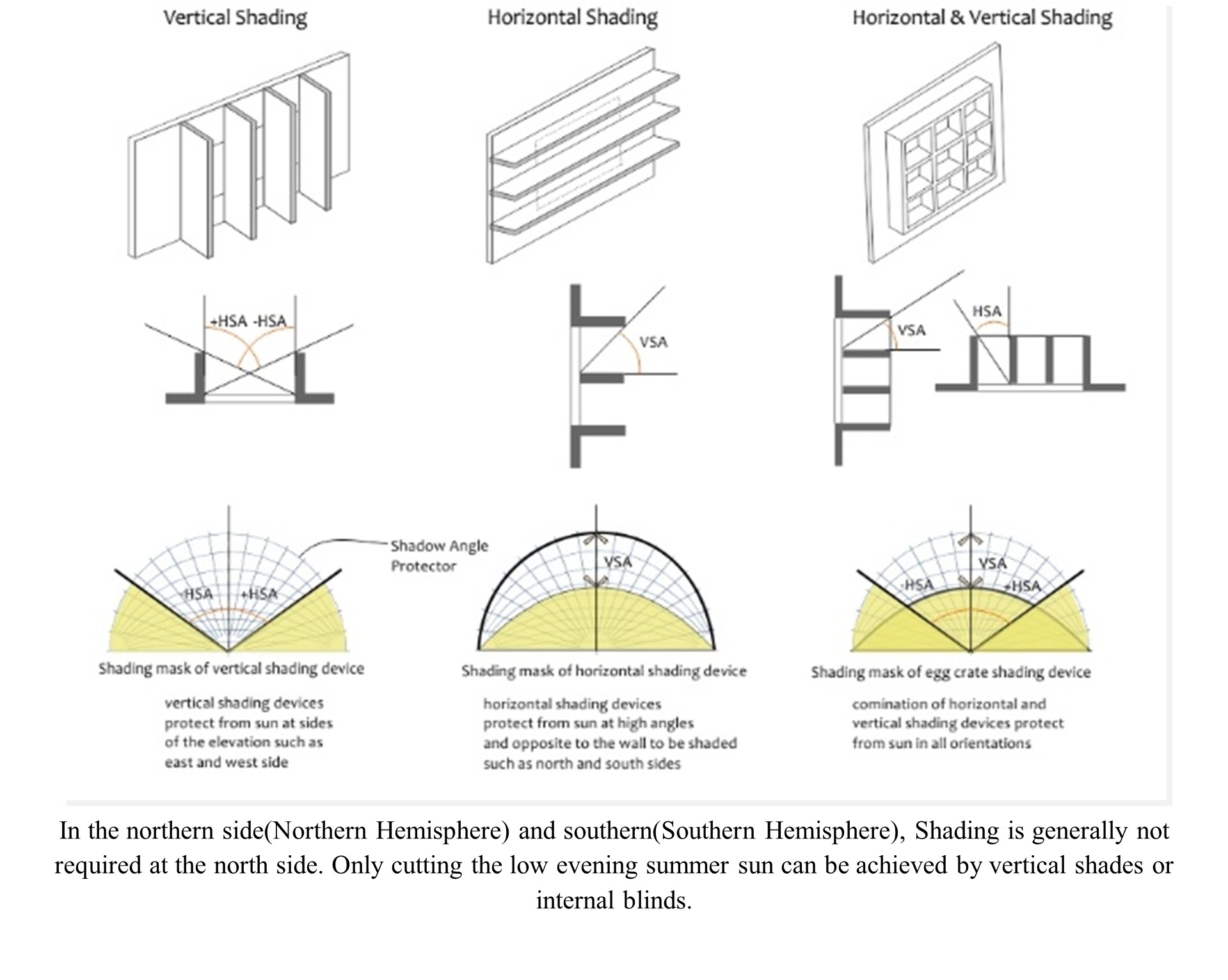
Internal shading devices, such as curtains, blinds, and smart glass, control incoming light and reduce glare. While their effect on heat reduction is limited, integrating smart technologies can improve lighting efficiency and occupant visual comfort.
External shading includes balconies, fixed or movable louvers, and vegetation. These are highly effective at blocking direct sunlight before it enters a space, significantly reducing indoor temperatures.
External shading is particularly essential in hot and sunny climates. When combined with vegetation, it also enhances visual quality and occupant well-being.
| Suitable Climate | Adjustable | Light Control | Thermal Performance | Shading Type |
| Temperate | Yes | High | Medium | Internal(curtains, blinds) |
| Hot and sunny | Yes | High | High | External(louvers, balconies) |
| All climates | No | Medium | Medium | Vegetation |
To achieve maximum efficiency, shading devices must be designed according to building orientation, regional climate, and requirements for light and heat control. Choosing the right type, size, and angle; possibly combined with vegetation or smart systems, optimizes their performance.
Simulation studies show that in some climates, combining passive shading with insulation can be more effective than using insulation alone, significantly reducing heating and cooling loads (sciencedirect.com).
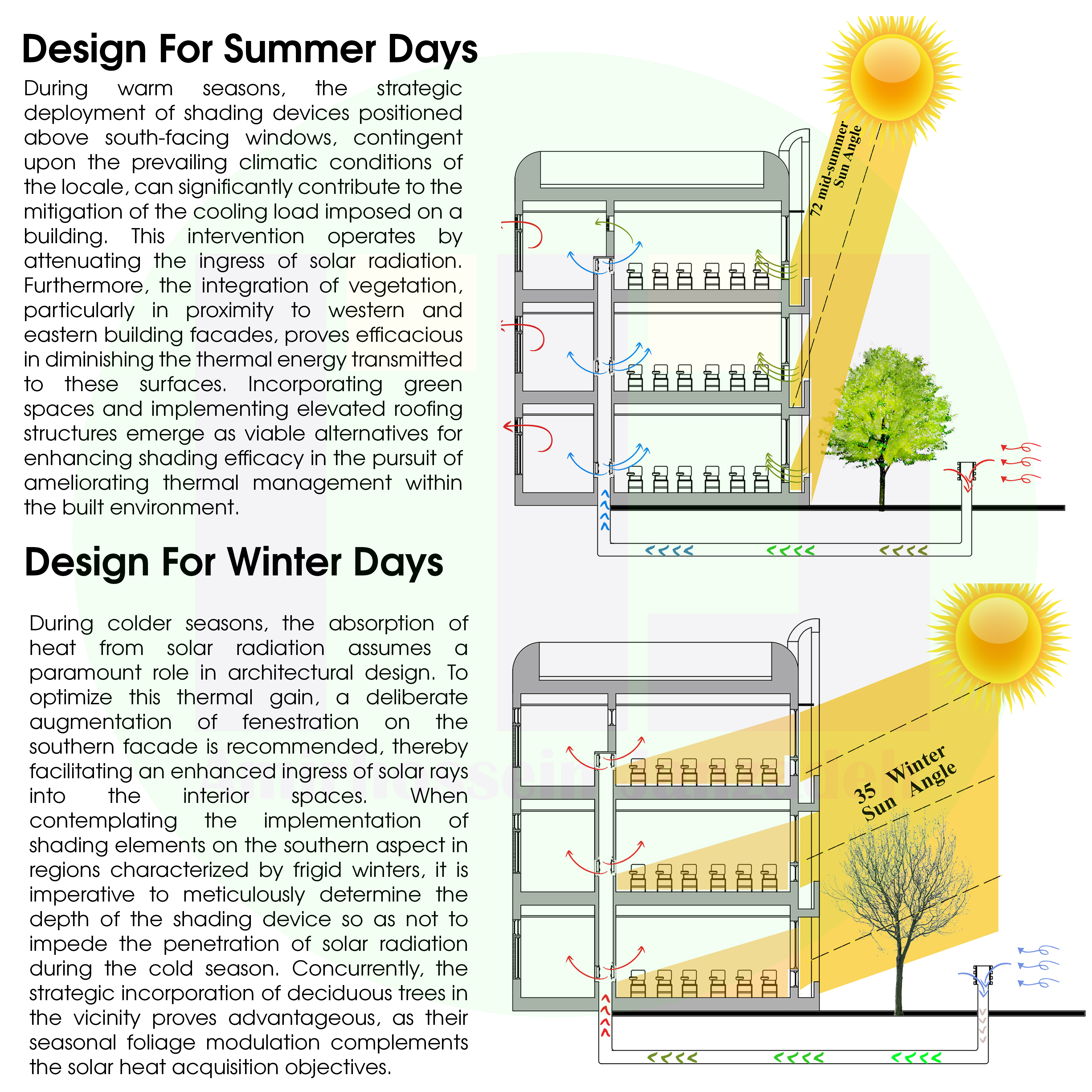
Planting deciduous trees around a building provides natural shade in summer and allows sunlight in winter. Vegetation on balconies or shading devices produces a similar effect, improving thermal comfort and overall living quality.
Adaptive shading systems with intelligent solar control can significantly reduce annual energy consumption and improve overall building performance (mdpi.com).
DesignBuilder software allows precise modeling of openings and shading devices in sustainable buildings. Key features include:
This software helps designers and engineers make informed decisions regarding shading design and selection.
Proper selection and design of solar control systems are essential for reducing building energy consumption and improving indoor thermal comfort. Recommended strategies include:
Consider your project’s climate and orientation to determine which shading type offers the best efficiency and comfort. For detailed analysis, use the recommended tools or contact our team for specialized DesignBuilder simulations.
If you found this article helpful, please share your feedback, link it with colleagues, or submit questions about shading design for future updates.
By controlling direct sunlight, they stabilize indoor temperatures and reduce thermal fluctuations.
Trees and vegetation reduce summer heat gain while allowing sunlight in winter.
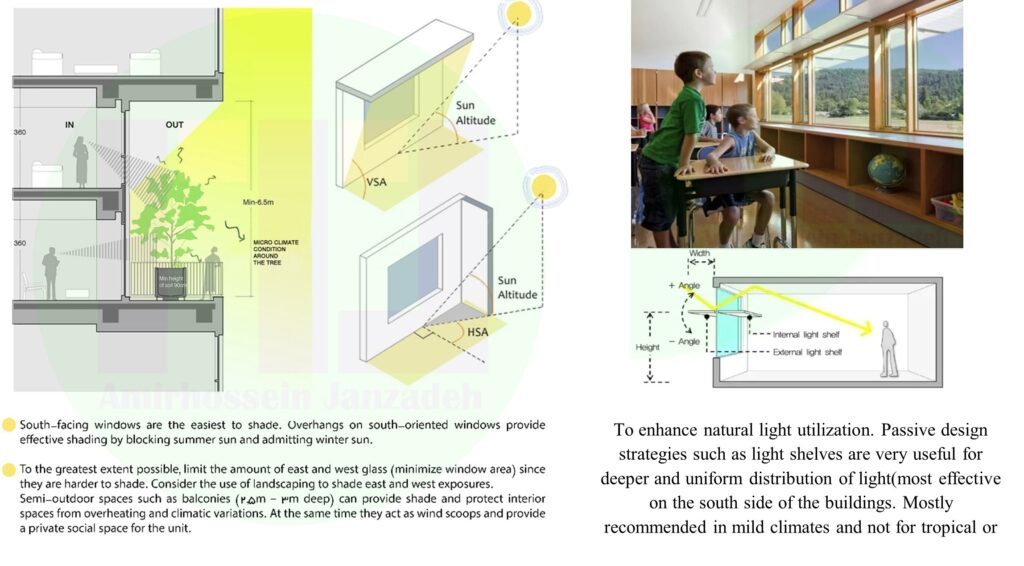
Smart movable louvers and light shelves reduce energy consumption for lighting and HVAC systems while directing natural light deeper into spaces.
External shading is effective in tropical regions, while horizontal shading enhances winter sunlight in colder regions.
Simulation tools like DesignBuilder allow analysis of shading effects on indoor temperature and lighting, ensuring optimal performance.
Olgyay, V. (1963). Design with Climate: Bioclimatic Approach to Architectural Regionalism. Princeton University Press
ASHRAE. (2021). ASHRAE Handbook—HVAC Applications. American Society of Heating, Refrigerating and Air-Conditioning Engineers
U.S. Department of Energy (DOE). EnergyPlus Documentation. Retrieved from https://energyplus.net/documentation
Yang, F., Zhou, H., Chen, J., Sun, Y., Wang, D., Sun, F., & Zhang, L. (2025). Energy‑Saving Performance and Optimization Study of Adaptive Shading System — A Case Study. Buildings, 15(11), 1961. https://doi.org/10.3390/buildings15111961
Authors. (2023). Energy performance of passive shading and thermal insulation in multistory hotel building under different outdoor climates and geographic locations. Case Studies in Thermal Engineering. https://www.sciencedirect.com/science/article/pii/S2214157X23002460